IMU News 137: May 2026
A Bimonthly Email Newsletter from the International Mathematical Union (pdf)
Editor: Yoshiharu Kohayakawa, Universidade de São Paulo, Brazil
Editorial: the IMU endorses the Leiden Declaration on Artificial Intelligence and Mathematics
Artificial intelligence (AI) is increasingly affecting our day-to-day mathematical research, whether it be the use of large language models, systems for symbolic computation and formalization, or the growing industrial interest in mathematics as a testing ground for automated reasoning. While many of these developments are exciting, they raise questions that the mathematical community cannot afford to leave unexamined.
The “Leiden Declaration on Artificial Intelligence and Mathematics”—published on June 2, 2026— addresses many key questions currently being raised.
The declaration grew out of the conference “Mechanization and Mathematical Research”, held in September 2025 at the Lorentz Center at Leiden University in the Netherlands. Around 60 participants from 10 countries, including mathematicians, computer scientists, philosophers, and social scientists, took part. In the six months after the conference, a smaller working group developed the declaration with extensive feedback from the mathematical community. The text reflects AI technologies and mathematical practice as of May 2026.
The IMU Executive Committee and its Committee on Publishing (CoP), chaired by Ilka Agricola, have followed the development of the declaration closely. Now, with its publication, the IMU is endorsing the Leiden Declaration on Artificial Intelligence and Mathematics.
I do not expect every colleague to agree with every sentence of the declaration. In fact, some of the reactions we have seen already show exactly why the declaration is useful, prompting consideration and discussion of what we want to protect, what we are willing to change, and where we need more clarity.
The declaration points to values that many mathematicians will immediately recognize: the central role of proof, the importance of understanding and clarity, the attribution of results to specific authors, the possibility of independent verification, and the shared responsibility of the community to evaluate work by standards of depth, difficulty, and significance.
It further identifies where pressures may first become apparent as AI enters more deeply into mathematical practice.
One concern is correctness. Current automated systems can produce arguments that look plausible but are in fact unreliable or simply false. This problem is not limited to informal text generation. It can also arise in the presentation and interpretation of formalized mathematics, especially when there is a gap between what a system verifies and what is actually proved when starting with poorly formulated definitions. Another concern is attribution. Mathematical work depends on proper credit to existing ideas and results. But many current AI systems are trained on published mathematical literature without preserving the scholarly norms on which that literature rests. They may thus generate output that synthesizes existing work, while failing to identify sources adequately. The declaration stresses that this does not lessen the obligation of human authors. Indeed, it increases the need for careful citation and explicit acknowledgment of intellectual debt.
The declaration also addresses the growing pressure on peer review and research evaluation. If automated tools make it easier to produce long, polished, and technically impressive texts, then the burden on referees may increase substantially. At the same time, there is a risk that results are promoted through press releases, blog posts, or other informal channels before established review processes take place. Claims of mathematical significance can thereby easily become exaggerated, with the contributions of earlier work obscured.
Two points in the declaration seem especially important. One is the risk of asymmetry in the relationship between mathematicians and companies. With access to powerful tools and computing resources already uneven, this could create new inequalities among countries, between institutions, and even within departments and research groups. The other is the risk that some areas of mathematics become fashionable simply because AI tools work well within them, rather than because the community judges these to be the most interesting or significant topics. That would be a real loss of autonomy for the discipline.
The declaration's recommendation to provide frameworks for collaboration with industry is therefore particularly important. While collaboration can of course be fruitful, it would be unrealistic to pretend that every useful partnership will meet the standards of academic openness in every respect. Thus mathematicians entering such collaborations must have support, guidance, and a clear understanding of the likely tradeoffs involved.
Finally, from a practical point of view, it calls on individual mathematicians to disclose their use of automated tools, to support the needs of reviewers, to uphold open science principles where appropriate, and to retain full responsibility for correctness and attribution. It also pushes back against the emerging habit of presenting mathematical results as if they were produced autonomously by a company or a model, with the human contribution disappearing from view. Whatever the future brings, transparency around human and machine involvement is essential. The declaration also encourages mathematicians to engage in public discourse, stay informed about emerging technologies, and think carefully about the ethical implications of the tools and collaborations they choose.
The recommendations addressed to mathematical organizations, funders, and policymakers are equally important. They include developing clear publication and review policies, maintaining standards of rigor, protecting authors’ rights, supporting public research laboratories and infrastructure, and resisting exaggerated claims about the capabilities of AI systems. These will no doubt play a part in how our community preserves both credibility and the conditions for reliable research.
The IMU endorses the Leiden Declaration because it is a timely, serious and balanced contribution to a discussion that is only just beginning. It asks the mathematical community to respond in a way that is transparent and guided by the values of our discipline.
Yet endorsement does not mean an end to the debate. On the contrary, it will hopefully prompt further discussions across different areas of mathematics and in different parts of the world.
The discussion will certainly continue at ICM 2026 in Philadelphia. Indeed, as part of the IMU panel “Challenges for Mathematical Research and Publishing” on Sunday, July 26, there will be a talk by Jim Portegies, the convener of the declaration’s working group, entitled “The Leiden Declaration on Artificial Intelligence and Mathematics”.
I hope many of us will join that session, not only because the topic is timely, but also because it offers an opportunity for us to come together and discuss these questions in an open forum.
The same IMU panel will also include a talk by Lynn Heller on “Fraudulent Publishing in Mathematical Sciences”, yet another topic that deserves the close attention of our community.
ICM 2026
The 2026 ICM is fast approaching. Readers who have not yet seen the following two articles published in the April 2026 issue of Notices of the AMS may find them of great interest:
- The ICM Comes to the United States: Philadelphia, July 23–30, 2026, by Allyn Jackson
- A Very Brief Political History of American-hosted International Congresses of Mathematicians, by Michael J. Barany


The Abel Prize 2026 Events and a lecture on the work of Gerd Faltings

This year’s Abel Prize Week (25–29 May 2026) is taking place as this newsletter is being prepared. The programme includes the Wreath-laying Ceremony at the Niels Henrik Abel Monument in the Royal Gardens, Oslo, on Monday, the Abel Prize Ceremony on Tuesday, the Abel Lectures on Wednesday, the Holmboe Prize Ceremony on Thursday, and the Abel Day in Kristiansand on Friday. Videos of the ceremonies and lectures will soon be available on the Abel Prize YouTube channel.
Already available on the channel is the lecture The Work of Gerd Faltings, by Jürg Kramer (Humboldt-Universität zu Berlin), a Math+ Special Talk delivered at the 29th Berlin Day of Mathematics on 22 May 2026.
A.M. Turing Award 2025
On 18 March 2026, the Association for Computing Machinery (ACM) announced Charles H. Bennett and Gilles Brassard as the recipients of the 2025 ACM A.M. Turing Award for their essential role in establishing the foundations of quantum information science and transforming secure communication and computing.
Among their contributions, Bennett and Brassard introduced in 1984 the first practical protocol for quantum cryptography, now known as BB84. They later proposed a method for quantum teleportation, showing how an arbitrary quantum state could be transmitted between remote parties using quantum entanglement, and devised an entanglement distillation protocol for strengthening imperfect entanglement into high-quality entanglement.
Charles H. Bennett is an American physicist who obtained his Bachelor's from Brandeis and his PhD from Harvard. He joined IBM Research in 1973, where he still works. His honors include the Wolf Prize in Physics, the Micius Quantum Prize, the BBVA Foundation Frontiers of Knowledge Award, and the Breakthrough Prize in Fundamental Physics. He is a Member of the U.S. National Academy of Sciences and a Foreign Member of the Royal Society.
Gilles Brassard is a Canadian computer scientist. He obtained his PhD from Cornell in 1979 under 1986 Turing Award laureate John E. Hopcroft and joined the Université de Montréal soon after, holding the Canada Research Chair in Quantum Information Science from 2001 to 2021. Like Bennett, he has received the Wolf, Micius, BBVA Frontiers of Knowledge, and Breakthrough Prizes. He is an Officer of the Order of Canada and of the Ordre national du Québec, a Fellow of the Royal Society, and an International Member of the U.S. National Academy of Sciences.
Breakthrough Prizes in Mathematics 2026
Frank Merle, of CY Cergy Paris Université and Institut des Hautes Études Scientifiques, is the 2026 laureate of the Breakthrough Prize in Mathematics, “for breakthroughs in nonlinear evolution equations, with regards to their stability, singularity formation, or resolution into solitons”.
The 2026 New Horizons in Mathematics Prize laureates are Otis Chodosh, Stanford University, “for contributions to differential geometry and the calculus of variations, including work on minimal surfaces and manifolds with positive scalar curvature”; Hong Wang, Institut des Hautes Études Scientifiques and New York University, “for work in harmonic analysis, partial differential equations, and geometric measure theory, including the local smoothing conjecture, Furstenberg set conjecture, and the Kakeya conjecture”; Vesselin Dimitrov, Caltech, and Yunqing Tang, University of California, Berkeley, “for work in Diophantine geometry, including the proof of the Atkin–Swinnerton-Dyer unbounded denominators conjecture and new irrationality results for special values of Dirichlet L-series (both joint with Frank Calegari).”
The 2026 Maryam Mirzakhani New Frontiers Prize laureates are Amanda Hirschi, IMJ-PRG, Sorbonne Université (PhD University of Cambridge 2023), “for contributions to symplectic topology”; Anna Skorobogatova, Clay Research Fellow and ETH Zürich (PhD Princeton University 2024), “for contributions to geometric measure theory”; and Mingjia Zhang, Princeton University and Institute for Advanced Study (PhD University of Bonn 2023), “for contributions to the theory of Shimura varieties”.
Visit the announcement page of the 2026 Breakthrough Prizes and the laureates page.
The Shaw Prize in Mathematical Sciences 2026
The Shaw Prize in Mathematical Sciences 2026 has been awarded in equal shares to Emmanuel Candès, Stanford University, USA, and Camillo De Lellis, Institute for Advanced Study, Princeton, USA, “for their breakthrough contributions to the use of deep techniques from mathematical analysis to rigorously understand applied problems in information theory, signal processing and statistics on the one hand, and to the study of singularities in geometric measure theory and fluid dynamics on the other”.
Emmanuel Candès was born in 1970 in Paris and is currently the Barnum–Simons Chair in Mathematics and Statistics at Stanford University. He received his Bachelor's from the École Polytechnique in 1993 and his PhD in Statistics from Stanford in 1998. After a brief period as Assistant Professor at Stanford, he joined Caltech in 2000, becoming the Ronald and Maxine Linde Professor of Applied and Computational Mathematics in 2006. He returned to Stanford in 2009. He was a plenary speaker at the International Congress of Mathematicians in 2014. He is a member of the U.S. National Academy of Sciences and the American Academy of Arts and Sciences.
Camillo De Lellis was born in 1976 in San Benedetto del Tronto, Italy, and is currently the IBM von Neumann Professor at the Institute for Advanced Study, Princeton. He received his Bachelor’s from the University of Pisa in 1999 and his PhD from the Scuola Normale Superiore di Pisa in 2002. He joined the University of Zürich in 2004, was promoted to Professor in 2005, and moved to the IAS in 2018. He was a plenary speaker at the European Congress of Mathematics in 2012 and the International Congress of Mathematicians in 2022. He is a member of the American Academy of Arts and Sciences, the German National Academy of Sciences Leopoldina, the Accademia dei Lincei, and Academia Europaea.
Clay Research Awards 2026
The Clay Research Awards, presented at the Clay Research Conference, recognize outstanding achievements in mathematical research. The 2026 Clay Research Conference will take place on 23 September at the Mathematical Institute, University of Oxford. The 2026 Clay Research Awards were announced on 14 April 2026:
- A Clay Research Award is made to Tuomas Orponen (Jyväskylä), Pablo Shmerkin (UBC), Hong Wang (IHES and NYU), and Joshua Zahl (Nankai) in recognition of their remarkable work on geometric problems in harmonic analysis, leading to the proof of the Furstenberg set conjecture in the plane and the Kakeya conjecture in three dimensions.
- A Clay Research Award is made to Robert Burklund (Copenhagen), Jeremy Hahn (MIT), Ishan Levy (IAS and CMI), and Tomer Schlank (Chicago) in recognition of their remarkable construction of counterexamples to Ravenel’s “Telescope Conjecture”.
- A Clay Research Award is made to Yu Deng (Chicago) and Zaher Hani (Michigan) in recognition of their remarkable derivation of the Boltzmann equation for long times, starting from a system of hard spheres.
ICHM Awards Event
ICHM Awards Event at Oxford—a wonderful afternoon in Oxford celebrating the historians who illuminate mathematics’ past!
On 6 March 2026, the International Commission on the History of Mathematics (ICHM) hosted a special celebration at the University of Oxford’s Mathematical Institute to recognise several recent honours awarded to distinguished historians of mathematics.
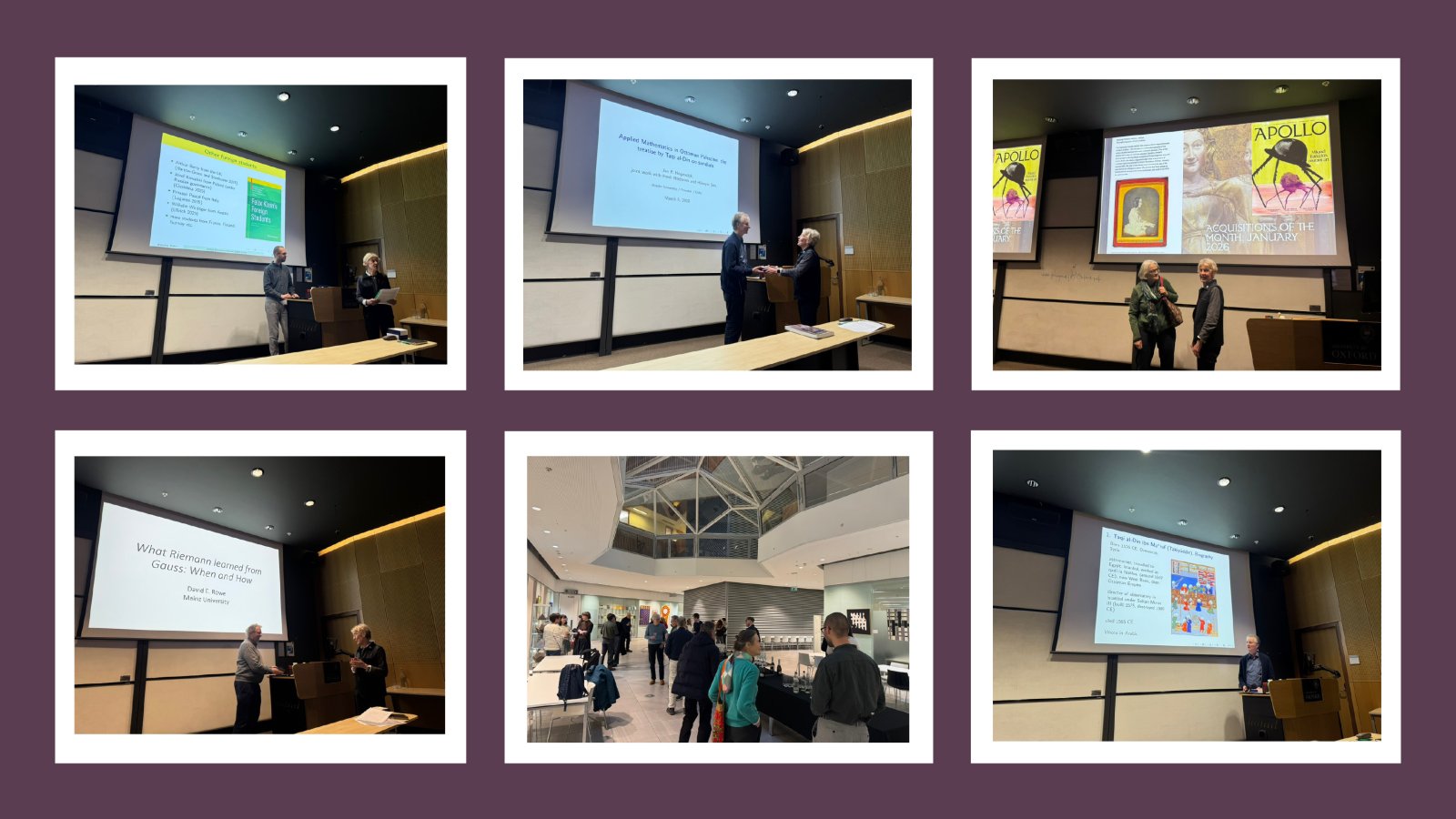
The event brought together colleagues and students to hear talks from prize recipients whose research spans cultures, centuries, and mathematical traditions. Their work reminds us how rich and diverse the global history of mathematics is.
The programme featured:
- Ursula Martin (University of Oxford), following her appointment as DBE (2025), who spoke on Ada Lovelace and the early history of computing at Oxford.
- Henning Heller (University of Bonn), recipient of the 2025 ICHM Montucla Prize for his article “Felix Klein’s teaching of Galois theory”, who delivered the lecture “Mellen Woodman Haskell (1863–1948): An American mathematics student of the Wanderlust generation”.
- David E. Rowe (University of Mainz), recipient of the 2025 ICHM Kenneth O. May Medal and Prize, one of the highest international distinctions in the history of mathematics, for his scholarship on modern mathematics in Germany in the 19th and early 20th centuries, who spoke on interactions between Riemann and Gauss.
- Jan Hogendijk (University of Utrecht), also recipient of the 2025 ICHM Kenneth O. May Medal and Prize, honoured for his pioneering research on the history of mathematics in the Islamic world, who spoke on applied mathematics in Ottoman Palestine and the work on sundials by Ottoman scholar Taqī al-Dīn.
As Chair of the ICHM, and along with our Past Chair, June Barrow-Green, it was a particular pleasure to see the community come together to celebrate these achievements and to recognise the scholars whose work continues to expand the horizons of our field.
Our sincere thanks go to our hosts in Oxford and to everyone who joined us for such a stimulating and collegial occasion. We are especially grateful to Chris Hollings, Ursula Martin, and Brigitte Stenhouse for their generous work in organising the local arrangements and ensuring the day ran so smoothly. Particular appreciation goes to June Barrow-Green, whose vision and dedication made the event possible and created such a wonderful opportunity to celebrate colleagues and bring our community together. Events like this remind us how vibrant and collaborative the international field of the history of mathematics continues to be.
Clemency Montelle
University of Canterbury
Chair of ICHM
News from the Commission for Developing Countries (CDC)
Preparations continue for the Commission for Developing Countries special activity at ICM 2026, to take place on 28 July in Philadelphia, under the theme “Mathematical Collaboration in the Global South and Creating Opportunities.”
The event will bring together CDC grantees, institutional partners, donors, and members of the mathematical community for an afternoon of presentations, discussion, and exchange focused on strengthening mathematical capacity through international collaboration.
We are pleased to confirm that the program will include short presentations by CDC supported researchers sharing experiences from different regions, as well as a moderated panel discussion featuring representatives from organizations and institutions engaged in mathematical development and cooperation. Confirmed panel participants currently include representatives from AMU, CIRM, SEAMS, UMALCA, the Simons Foundation, and the IMU CDC community.
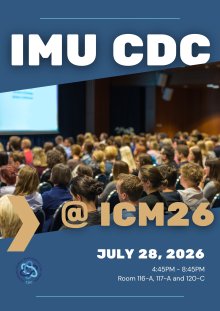
A poster exhibition by institutions contributing to mathematical development in emerging regions will highlight activities supported through CDC programs and initiatives.
The CDC special activity at ICM 2026 continues its long-standing tradition of creating spaces for dialogue and collaboration to support sustainable mathematical development in emerging regions at the International Congresses of Mathematicians. We look forward to welcoming colleagues from around the world in Philadelphia.
Current opportunities and deadlines. Several CDC-supported programs and opportunities are currently open and accepting applications:
- Conference Support Program. Next deadline: July 15, 2026, for conferences starting after November 15, 2026
- IMU-Simons Research Fellowship Program for Developing Countries. Next deadline: July 15, 2026, for research visits starting between December 1, 2026, and December 1, 2027
- Abel Visiting Scholar Program for Graduate Students. Application deadline: September 1, 2026, for research visits starting between February 1, 2027, and December 31, 2027
- Volunteer Lecturer Program. Next deadline: October 15, 2026, for courses to be held between March 1, 2027, and March 1, 2028
News from the Committee for Women in Mathematics (CWM)
World Meeting for Women in Mathematics (WM)² 2026. The World Meeting for Women in Mathematics (WM)², a satellite event of ICM 2026, will take place on July 22, 2026, at the Pennsylvania Convention Center in Philadelphia, and will also be accessible online. The program includes four research lectures, group discussions over lunch, a poster session, and a panel discussion. Please visit the (WM)² webpage for details and updates.
We are pleased to offer limited travel support for students, postdoctoral fellows, and other early-career researchers to attend (WM)². This funding has been generously provided by the Pacific Institute for the Mathematical Sciences, the Centre de Recherches Mathématiques, and the Fields Institute for Research in Mathematical Sciences. Submit your application via this webform. The deadline is June 4, 2026.
Submissions for the poster session are now open to participants attending (WM)² in person. We welcome contributions in any area of mathematics, broadly construed, aimed at a general mathematical audience, as well as outreach projects or activities related to women in mathematics. The webform for poster submissions is available here.
To encourage discussion and new connections during lunch, participants are invited to suggest table topics by submitting a title, a short description, and the discussion language. Lunch tables will be organized around these topics, with participants choosing tables based on their interests. The call for topics for the group discussions can be found here.
For instructions on how to register for (WM)², please visit this webpage. There is no registration fee for online participation.
We look forward to welcoming the mathematical community to (WM)², either in person in Philadelphia or online!
AWM/CWM Panel Discussion at ICM 2026. We warmly invite the entire mathematical community to attend or watch the panel discussion “Finding and Defining Success in Mathematics: Pathways and Measures,” which will take place on July 24 at ICM 2026, with the participation of Annalisa Crannell, Fern Hunt, Emily Riehl, and Shelby Wilson.
Mathematics has often emphasized a narrow vision of what a successful career can look like. This panel expands that horizon by celebrating the many dynamic ways success can emerge across research, leadership, industry, and public engagement. Bringing together diverse experiences, perspectives, and insights, the discussion will explore how mathematicians navigate, shape, and define success along different professional pathways. Our hope is to inspire broad and inclusive understandings of achievement and impact across our field.
This panel is jointly organized by the Association for Women in Mathematics (AWM) and the Committee for Women in Mathematics (CWM).
May 12, 2026—A Global Celebration of Women in Mathematics. In 2026, May 12 — Celebrating Women in Mathematics once again brought together communities across the globe in a vibrant celebration of women in mathematics. This year’s edition also paid special tribute to Sophie Germain, with many events dedicated to her life and mathematics in honor of the 250th anniversary of her birth.
As of May 19, 2026, more than 190 events from over 60 different countries had been registered on the May 12 website. This does not yet provide the full picture, as the numbers continue to grow: May 12 events may take place until June 15, and additional events are still being registered.
In this 8th edition of the May 12 initiative, arrangements were made to offer free screenings of the films Je suis Sophie Germain (I Am Sophie Germain) and Secrets of the Surface: The Mathematical Vision of Maryam Mirzakhani. Volunteers from the May 12 network prepared subtitles for Je suis Sophie Germain in 18 different languages.
The May 12 initiative is sponsored by CWM and coordinated by a group that includes representatives from various continental organizations supporting women in mathematics.
Carolina Araujo and Hélène Barcelo
Chair and Vice-Chair of the IMU Committee for Women in Mathematics
News from the International Day of Mathematics (IDM)
The Mathematics and Hope webinar. The recording of the webinar Mathematics and Hope, jointly organized by UNESCO and IMU on March 13, 2026, is online. You can watch the keynote lecture of Edward Frenkel in a video he has had specially prepared after his presentation. You can also reach the message of Pope Leo XIV here.
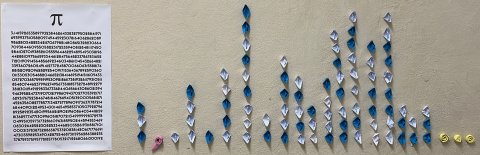
The 2027 IDM theme. We want to hear your ideas for the theme of the next IDM. You have until June 8, 2026, to think and send us your suggestions via the open call for the IDM theme 2027. Every year, the theme is chosen to flavour the celebration on March 14, to spark creativity and to bring light to connections between mathematics and all sorts of fields, concepts, and ideas. The IDM themes of the previous years have been:
- 2020: Mathematics is Everywhere
- 2021: Mathematics for a Better World
- 2022: Mathematics Unites
- 2023: Mathematics for Everyone
- 2024: Playing with Math
- 2025: Mathematics, Art, and Creativity
- 2026: Mathematics and Hope
Betül Tanbay
Chair of the IDM Governing Board
Subscribing to IMU News
To subscribe to IMU News, please click here. When you subscribe, you will receive an e-mail message to confirm your subscription so that misuse will be minimized.
IMU will not use the list of IMU News emails for any purpose other than sending IMU News, and will not make it available to others.
Previous issues can be seen here.