
IMU News 136: March 2026
A Bimonthly Email Newsletter from the International Mathematical Union (pdf)
Editor: Yoshiharu Kohayakawa, Universidade de São Paulo, Brazil
Editorial
The IMU Executive Committee has issued a statement regarding the ICM in Philadelphia in July 2026. This statement has been sent to the Adhering Organizations in the IMU AO Circular Letter 4/2026.
The statement reads as follows.
A statement from the International Mathematical Union
Concerns have been raised within the mathematical community about holding the International Congress of Mathematicians (ICM) in the United States this July.
Promoting international exchange is at the core of the IMU’s mission. At a time when international collaboration and science face serious challenges, we strongly believe that holding the ICM in person in Philadelphia is especially important.
We understand the concerns about entering the United States, as well as about feeling safe and welcome in Philadelphia and at the Congress. The Local Organizing Committee is fully committed to providing a safe and welcoming environment for all participants and has recently made additional arrangements to help mitigate risk.
The Local Organizing Committee has also confirmed that recordings of all sessions will be made available online, after a short editing process.
We look forward to meeting you in Philadelphia.
The Executive Committee of the IMU
30 March 2026
Many readers will also have already received a letter from the Local Organizing Committee of ICM 2026, which has been published on ICM’s website, and is reproduced below.
Dear Colleagues,
We warmly invite mathematicians from around the world to participate in the upcoming International Congress of Mathematicians (ICM), to be held in Philadelphia. The ICM is our field’s most important gathering—a celebration of mathematical achievement and a reaffirmation of the international character, unity, and shared purpose of our discipline. We very much look forward to welcoming colleagues from all regions and backgrounds to this historic Congress.
In recent months, some members of our community have expressed concerns regarding the safety and well-being of participants in the context of today’s politically fractured climate. We take these concerns seriously. The Organizing Committee is fully committed to providing a safe, welcoming, and respectful environment for all attendees. The ICM is an academic gathering devoted to mathematics—its ideas, its practitioners, and its global community—where participation is centered on scholarly exchange. We are working closely with local partners to ensure that the Congress proceeds as planned and that participants can focus fully on the scientific and communal goals of the meeting.
Beyond these practical considerations, we wish to emphasize the deeper purpose and spirit of the ICM. For more than a century, the Congress has existed to honor mathematicians from all parts of the world and to bring together our community across borders, cultures, nationalities, and ethnicities. This commitment to internationalism and mutual respect is not incidental; it is central to who we are as mathematicians and to how mathematical progress is made.
At moments when political forces threaten to fragment the international scientific community, the ICM stands for the opposite principle: openness, solidarity, and shared intellectual purpose. Gathering in Philadelphia is not only an academic act, but also an affirmation that mathematics transcends political divisions and that our community remains united in its values. We believe strongly that engagement, presence, and dialogue are essential to upholding the ideals that the ICM represents.
We therefore encourage mathematicians from the United States and from around the world to attend the ICM. Your participation honors our colleagues globally, strengthens our shared institutions, and affirms our collective commitment to an open and inclusive mathematical community. Standing together—calmly, peacefully, and resolutely—is the most effective way to preserve the unity and international character of our field.
We look forward with great enthusiasm to welcoming you to Philadelphia and to making ICM 2026 a successful, inspiring, and truly international gathering.
On behalf of the Local Organizing Committee of ICM 2026
Jalal Shatah
Silver Professor of Mathematics
Courant Institute — New York University
Gerd Faltings awarded the 2026 Abel Prize

The Norwegian Academy of Science and Letters has awarded the Abel Prize for 2026 to Gerd Faltings, of the Max Planck Institute for Mathematics, Bonn, Germany, “for introducing powerful tools in arithmetic geometry and resolving long-standing diophantine conjectures of Mordell and Lang”.
Readers are invited to access a recording of the 2026 Abel Prize Announcement Ceremony on the Abel Prize YouTube channel. In the ceremony, Annelin Eriksen, President of the Norwegian Academy of Science and Letters, announces the laureate, and Helge Holden, Chair of the 2026 Abel Committee, reads the full citation for the winner. This is followed by a popular presentation of Faltings’ work and an interview with the laureate. The press release, the citation, and a biography are available at the press room page of the Abel Prize website.
Faltings was born in 1954 in West Germany. After completing his PhD he spent a year as a research fellow at Harvard, and by age 28 had become a full professor at the University of Wuppertal. In 1983 he proved the long-standing Mordell conjecture — establishing that a wide class of diophantine equations has only finitely many rational solutions — an achievement that made him famous overnight. He later moved to Princeton University in 1985, and in 1994 returned to Germany to join the Max Planck Institute for Mathematics in Bonn, where he became a director and helped build a world-leading centre for arithmetic algebraic geometry, eventually becoming emeritus director in 2023.
Faltings was awarded the Fields Medal in 1986. He was an invited speaker at the International Congress of Mathematicians in 1986 and in 1994. Later distinctions include the Leibniz Prize (1996), the von Staudt Prize (2008), the Heinz Gumin Prize (2010), the King Faisal International Prize (2014), the Shaw Prize (2015), the Cantor Medal (2017), and his induction to the Order Pour le Mérite for Sciences and Arts in 2024. He is also a member of numerous learned academies, including the Royal Society, the National Academy of Sciences (USA), and the Norwegian Academy of Science and Letters.
Heisuke Hironaka passes away
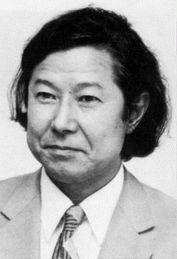
Heisuke Hironaka, who was awarded the Fields Medal in 1970 for his work in algebraic geometry, passed away in Tokyo on 18 March 2026, aged 94.
Born in Yamaguchi, Japan, on 9 April 1931, Hironaka studied at Kyoto University before moving to Harvard University, where he completed his doctorate in 1960 under the direction of Oscar Zariski. He held professorships at Brandeis, Columbia, and Harvard universities, becoming a full professor at Harvard in 1968. He also served as director of the Research Institute for Mathematical Sciences at Kyoto University from 1983 to 1985 and as president of Yamaguchi University from 1996 to 2002. Throughout his career he championed mathematical education, founding summer seminars for students and establishing the Japan Association for Mathematical Sciences in 1984.
Among other distinctions, he received the Asahi Prize (1967), the Japan Academy Prize (1970), a Guggenheim Fellowship (1971), Japan's Order of Culture (1975), the Legion of Honour (2004), and the Harvard Centennial Medal (2011). He was a member of the Japan Academy, the American Academy of Arts and Sciences and academies in France, Russia, Korea and Spain.
EMS Press announces full open access with Subscribe to Open
The EMS Press, the publishing house of the European Mathematical Society, announced a third consecutive year of full open access across all 22 of its Subscribe to Open (S2O) journals. All articles published in 2026 volumes will carry a CC-BY 4.0 licence, guaranteeing open access in perpetuity. Readers are invited to check the detailed announcement on this page.
Subscribe to Open is a subscription model that allows a publisher to convert journals from gated access to Open Access. For details, visit the Subscribe to Open website.
2025 Report on gender equality in scientific organizations launched
The 2025 report on gender equality in scientific organizations was launched on the International Day of Women and Girls in Science, 11 February, at the webinar “Women in scientific organizations: global evidence from science academies and unions”.
The report, “Towards gender equality in scientific organizations: assessment and recommendations”, by Léa Nacache, Marie-Françoise Roy and Catherine Jami, presents the most comprehensive global assessment to date of gender equality in scientific organizations. It reports the findings of a 2025 global study conducted jointly by the International Science Council (ISC), the InterAcademy Partnership (IAP), and the Standing Committee for Gender Equality in Science (SCGES).
Readers are invited to access the report on its website.
CIMPA-ICTP Research in Pairs
The CIMPA-ICTP “Research in Pairs” fellowship programme enables mathematicians based in a developing country to come to Europe to collaborate with a colleague. The two researchers are expected to work together on a research project, mainly in the European colleague’s institute.
The call for applications for stays in 2027 is open until 24 April 2026. For details concerning the application process, eligibility and others, readers are invited to visit this CIMPA page or this ICTP page.
A DORA resource: a course on responsible research assessment

The IMU is a signatory to DORA, the San Francisco Declaration on Research Assessment, a worldwide initiative covering all scholarly disciplines.
DORA recently launched an introductory course on responsible research assessment (RRA). This is a short course designed to provide interested researchers with a foundational understanding of research assessment and its reform. The course is free and open to anyone at any career stage seeking to learn about RRA.
To learn more about the course, visit the announcement here.
Shaw Prize in Computer Science announced
Considered amongst the world’s most prestigious awards, the Shaw Prize, founded by the late Hong Kong media mogul Run Run Shaw and awarded for the first time in 2004, is an international award that annually honours outstanding achievements in the fields of Astronomy, Life Science and Medicine, and the Mathematical Sciences.
In January this year, the Shaw Prize Foundation announced “its first major expansion in over two decades: the establishment of The Shaw Prize in Computer Science, a new prize category to honour pioneering breakthroughs in this transformative field that is reshaping the modern world”.
A recording of the announcement ceremony is available, as is the press release of the announcement.
News from the International Commission on Mathematical Instruction (ICMI)
Report on the first ICMI Awardees Multimedia Online Resources (AMOR) Webinar – February 24, 2026. In order to make the ICMI AMOR Project better known and more used, the ICMI AMOR Advisory Board has decided to launch a series of webinars. The first webinar took place on Tuesday, February 24, 2026. In order to reach as many people as possible worldwide, it was repeated in two sessions, considering all time zones: at 8 a.m. and at 6 p.m. UTC.
The purpose of this first webinar was to present the whole project and to discuss some of its uses. Here is the plan of the webinar with the name of the presenters:
- Origin and genesis of the project (5 min) (Jean-Luc Dorier)
- Presentation of 3 units:
- Michèle Artigue (5 min)
- Marianna Bosch for Yves Chevallard’s (5 min)
- Anna Sfard (5 min)
- Some uses of AMOR
- Nadav Ehrenfeld (5 min)
- Sébastien Jolivet (5 min)
- Huang Xingfeng (5min)
- Open discussion (25 min)
There were about 130 and 100 participants at the first and second sessions respectively and, in both cases, active discussions indicated wide interest and different uses for the project.
The video of the presentation with the discussions from the two sessions is now accessible on the ICMI website and on the ICMI AMOR YouTube channel.
Announcement: Second Webinar in the ICMI AMOR Series. The second webinar in the series devoted to ICMI AMOR will take place on Monday, April 27th, 2026. There will be a first session at 10 a.m. UTC in English and a second session at 4 p.m. UTC in Portuguese. Check the time in your respective countries.
This webinar will be devoted to
- Ubiratan D’Ambrosio unit (Felix Klein Award 2005) made by Milton Rosa and Daniel Clark Orey and
- Terezinha Nunes unit (Hans Freudenthal Award 2017) made by herself,
with presentations of the authors of the units and also some testimonies of people who used these units in different contexts.
In order to be informed and receive the Zoom link for each webinar session, you must subscribe to the ICMI Newsletter. Please note that when connecting to a webinar session you agree that the session is recorded and that the recording is posted on the ICMI Website and the ICMI AMOR YouTube channel. You can keep your video and microphone closed during the whole session.
Participants are encouraged to visit the ICMI AMOR website and our YouTube channel prior to the webinar.
ICMI Study 27 “Mathematics Education and the Socio-Ecological”: Update on Study Volume Preparation, by Alf Coles and Kate le Roux, ICMI Study 27 Co-Chairs. Following a successful Study Conference (January 22–25, 2025, in Manila, The Philippines), Study participants are well underway in their writing for the Volume. Our design of the Volume has retained the four themes used for the Conference organization on account of their richness individually and together. The four themes are: Aims of Mathematics Education; Scales of Mathematics Education; Resources of/for Mathematics Education; and Mathematics Education Futures. In the Volume, each theme
- has an introduction that grounds the theme in previous thinking and establishes the specific, coherent contribution of the theme to knowledge on the topic of “Mathematics Education and the Socio-Ecological.” These are co-authored by the International Program Committee theme leads;
- comprises three or four chapters, co-authored by three to eight authors, that build substantially on the knowledge produced for the Conference Study Proceedings.
In addition, each of the four plenary papers develops one or more of the Study themes.
The first drafts of the 15 theme chapters have now received three reviews. Each chapter was reviewed by a Volume author within the same theme, a Volume author writing on a different theme, and a critical reader from outside the Study. Thus, taken together, the review voices offer insights on each chapter’s angle and contribution to a specific theme; threads to ideas in other themes; strengths in terms of the topic as a whole; and any ‘blind spots’ to be considered. We hope to have the second drafts of most chapters by March 2026 and are aiming to have a full draft of the book later in 2026.
As Study Co-Chairs we are excited by the Volume chapters we have read so far. These advance the knowledge produced in the Study Proceedings, offering novel insights. These chapters challenge our thinking about mathematical knowledge, curriculum, mathematics teacher education, and technologies, amongst other topics. They prompt questions about what is valued, who decides, who participates, and in what relations — and where there are absences. The Volume writing process itself has much to say about the topic: Our knowledge-making is collaborative, harnessing voices from a range of socio-ecological contexts, and necessitates nuanced intellectual work between theorizing and place-based cases of socio-ecological practice.
We are also delighted to see scholarship on mathematics education and the socio-ecological expanding in other arenas of mathematics education, often in collaborations within and beyond ICMI Study 27 participants. This includes recognition of the topic within formal conference and journal structures. These arenas include, but are certainly not restricted to international communities such as the International Congress on Mathematical Education (ICME), the International Group for the Psychology of Mathematics Education (PME), and Mathematics Education and Society (MES) as well as regional communities such as the Southern African Association for Research in Mathematics, Science and Technology Education (SAARMSTE), and the Congress of the European Society for Research in Mathematics Education (CERME). We encourage readers to seek out the socio-ecologically related work taking place in these spaces and consider getting involved!
News from the Commission for Developing Countries (CDC)
The Committee for Developing Countries (CDC) is hosting a special activity at ICM 2026, on 28 July in Philadelphia. The event will highlight the importance of strengthening mathematical development in the Global South through collaboration. We are pleased to share further details as planning continues.
The event will be held under the theme “Mathematical Collaboration in the Global South and Creating Opportunities” and will combine short grantee experience presentations, a moderated panel discussion, as well as a poster exhibition. It will bring together CDC grantees, institutional partners, donors, and members of the mathematical community to share impact, exchange experiences, and discuss challenges and opportunities in creating sustainable mathematical capacity in emerging regions.
This activity builds on the CDC’s longstanding tradition of ICM events, including at ICM 2014 (Seoul) and ICM 2018 (Rio de Janeiro). At ICM 2014 in Seoul, CDC’s special session welcomed over 250 participants, including representatives from scientific foundations and institutions. The 2026 activity builds on this tradition, continuing the CDC’s role in making space for dialogue and collaboration. We hope to welcome just as many colleagues, if not more in Philadelphia!
Colleagues planning to attend ICM 2026 are warmly invited to mark their calendars for 28 July to join us.
Current Opportunities and Deadlines. Several CDC-supported programs and opportunities are currently open and accepting applications:
- Volunteer Lecturer Program. Next deadline: April 1, 2026, for courses to be held between August 1, 2026, and August 1, 2027
- Conference Support Program. Next deadline: April 15, 2026, for conferences starting after August 15, 2026
- IMU-Simons Research Fellowship Program for Developing Countries. Next deadline: April 15, 2026, for research visits starting between August 15, 2026, and August 15, 2027
- IMU Breakout Graduate Fellowship Program. Nomination deadline: May 30, 2026
- Graduate Research Assistantships in Developing Countries (GRAID) Program. Nomination deadline: May 15, 2026
News from the Committee for Women in Mathematics (CWM)
World Meeting for Women in Mathematics (WM)² 2026. CWM is pleased to announce that registration for the upcoming World Meeting for Women in Mathematics (WM)² is now open. (WM)² will take place on July 22, 2026, at the Pennsylvania Convention Center in Philadelphia, and will also be accessible online.
To register for (WM)², please visit the ICM registration page.
Please note the following:
- If you have already registered for the ICM, click on the “Already registered?” link on the ICM registration page and modify your registration using your confirmation code by selecting “Modify Registration.” Under the “Additional Information” tab, you will find “Sessions,” where you can register for (WM)². If you are a recipient of an ICM travel support grant, your registration fee will be waived at the final step.
- If you are registering for the ICM at the same time, you will find the option to register for (WM)² under “Additional Information” > “Sessions.”
- Those planning to attend only (WM)² (either in person or online) and not the ICM may register for (WM)² only.
- There is no registration fee for online participation.
Please visit the (WM)² webpage for updates.
We look forward to welcoming the mathematical community to (WM)², either in person in Philadelphia or online!
May 12, 2026. The 2026 edition of the May12 — Celebrating Women in Mathematics initiative has been launched and is now available on the May12 website.
May 12 marks the birthday of Maryam Mirzakhani. This date was chosen to celebrate Women in Mathematics in her memory, with the goal of inspiring women worldwide, celebrating their achievements in mathematics, and fostering an open, welcoming, and inclusive work environment for all.
In this 8th edition of the May12 initiative, arrangements have been made to offer free screenings of the films Je suis Sophie Germain (I Am Sophie Germain) and Secrets of the Surface: The Mathematical Vision of Maryam Mirzakhani, with subtitles available in many languages. Je suis Sophie Germain is presented on the occasion of the 250th anniversary of the birth of Sophie Germain (April 1, 1776). Secrets of the Surface: The Mathematical Vision of Maryam Mirzakhani is made available courtesy of Zala Films and director George Csicsery. Both films may be screened between May 1 and May 20.
Please visit the May12 website to request access to the films and to register your May12 event.
The May12 initiative is sponsored by CWM and coordinated by a group that includes representatives from various continental organizations supporting women in mathematics.
Carolina Araujo and Hélène Barcelo
Chair and Vice-Chair of the IMU Committee for Women in Mathematics
News from the International Day of Mathematics (IDM)
IDM 2026 School Program. The IDM 2026 School Program, sponsored by the Simons Foundation, was offered to around 200 schools in four languages: English, French, Arabic and Spanish. It started with virtual training workshops proposing activities and the new activity on “the evolution of trust”. Schools then collaborated, exchanged information and posted their creations in four WhatsApp groups, one in each language.
The “Mathematics and Hope” webinar. UNESCO and IMU jointly organized the webinar “Mathematics and Hope” and UNESCO declared massive participation! Counting the number of countries, even just in the chat, led to a count of more than fifty different countries with wonderful comments and shared enthusiasm. One new idea this year was to have a host country. The webinar was chaired by the IDM Chair from Miletus (Türkiye), hometown of Thales, and she read the message received on the occasion from Pope Leo XIV, who taught Mathematics and Physics. The keynote address by Edward Frenkel reminded all the world the power and universality of mathematics and its need for the future. The game “evolution of trust” was explained by the IDM Founding Chair Christiane Rousseau. Katie Chicot from the Open university moderated a lively panel with five participants from five continents. Khaled El-Enany, Director-General of UNESCO, on the occasion of the International Day of Mathematics, sent a message in five languages. The recording of the webinar is available on the UNESCO website and will soon be on the IDM website.
IDM map. This year also around one thousand events were registered on the IDM map, from more than one hundred countries. A lot of activity took place on March 14 on social media.
Press releases. Press releases for IDM 2026 have been published in English, French and Turkish. A source copy has been downloaded and translated into several other languages.
Betül Tanbay
Chair of the IDM Governing Board
Subscribing to IMU News
To subscribe to IMU News, please click here. When you subscribe, you will receive an e-mail message to confirm your subscription so that misuse will be minimized.
IMU will not use the list of IMU News emails for any purpose other than sending IMU News, and will not make it available to others.
Previous issues can be seen here.