IMU News 138: July 2026
A Bimonthly Email Newsletter from the International Mathematical Union (pdf)
Editor: Yoshiharu Kohayakawa, Universidade de São Paulo, Brazil
Editorial: 2026 IMU General Assembly and ICM
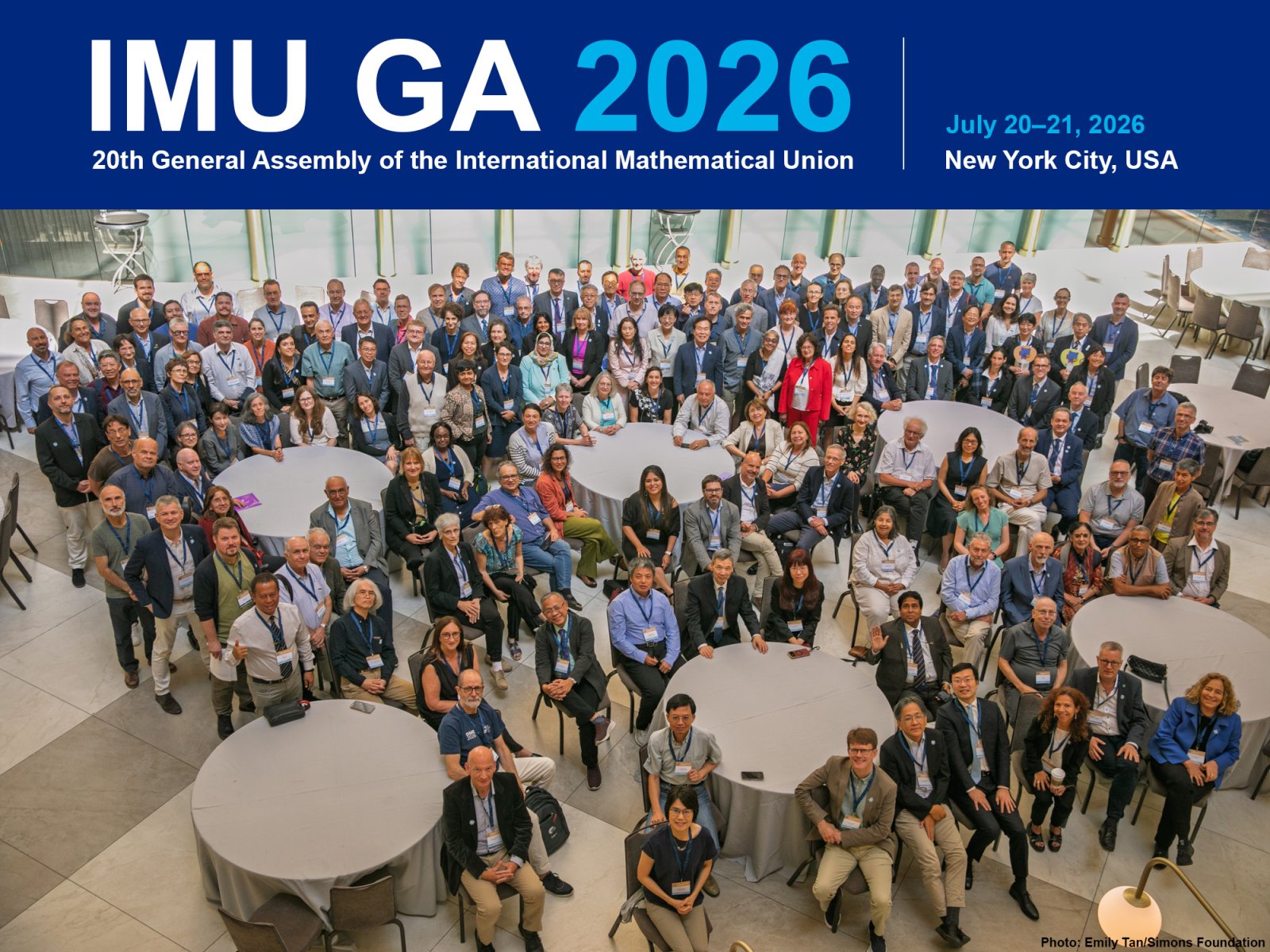
The General Assembly in New York. The General Assembly (GA) met on July 20 and 21. In total, 157 delegates representing 66 countries attended, 25 of them remotely. Together with members of the IMU Executive Committee, representatives of IMU commissions and committees, representatives of Affiliate Members, candidates for election, and staff of the IMU Secretariat, around 200 people took part in the GA. Several of its important decisions are outlined below, although many other issues were discussed. A complete list of resolutions can be found on the IMU website. Once completed, the minutes of the General Assembly will be sent to the Adhering Organizations.
First, the General Assembly expressed its deep gratitude to Germany, and in particular to the Weierstrass Institute for Applied Analysis and Stochastics (WIAS), for their continued generous support of the IMU Secretariat.
Next, the General Assembly elected the IMU leadership for the term 2027–2030:
- President: Ulrike Tillmann
- Secretary General: Christoph Sorger
- Vice-Presidents: Xuhua He and Gigliola Staffilani
- Members-at-Large: JongHae Keum, Mahan Mj, Kavita Ramanan, Tatiana Toro, Josephine Wairimu Kagunda, and Tamar Ziegler
The new Executive Committee will take office on January 1, 2027; until then, the present Executive Committee remains in office.
The Assembly elected the following leadership and regional Members-at-Large of the Commission for Developing Countries (CDC):
- President: Balázs Szendrői
- Secretary for Policy: K.N. Raghavan
- Secretary for Grant Selection: Peng Shan
- African Member-at-Large: Norbert Hounkonnou
- Asian Member-at-Large: Umida Baltaeva
- Latin American Member-at-Large: Mariel Sáez Trumper
For the International Commission on the History of Mathematics (ICHM), Guillermo P. Curbera and Carmen Martínez Adame Isais were elected as IMU representatives to its Executive Committee.
Beyond the elections, another major decision was the creation of the Ladyzhenskaya Medal, a new IMU award honoring Olga Aleksandrovna Ladyzhenskaya. The medal will be awarded every four years at the ICM to up to two mid-career mathematicians and will be open to all branches of mathematics. It will be presented for the first time as an official IMU award at ICM 2030. Svetlana Jitomirskaya, who received the commemorative Ladyzhenskaya Prize in Helsinki in 2022, will be recognized as the first recipient of the Ladyzhenskaya Medal. The new medal recognizes an important career stage not previously represented among the IMU awards.
The Assembly approved the financial reports for 2022–2025 and the budget for 2027–2030. It set the unit contribution for membership dues at €1,490 for the coming term, a modest inflationary adjustment from the present €1,460. The Assembly also received the first report on the IMU Reserve Fund, established by the General Assembly in 2022 to help Adhering Organizations facing temporary extreme hardship. The Fund helps preserve participation in the Union when circumstances beyond the control of a mathematical community make that participation difficult.
A further resolution concerned international professional interaction. It called on Adhering Organizations to regard artificial restrictions on professional contacts between mathematicians from different countries as unacceptable, including restrictions affecting publication, peer review, access to conferences, or participation in them.
Finally, after considering three excellent proposals, from Dublin/Glasgow, Hong Kong and Tokyo, the General Assembly chose the venues for 2030. The 21st IMU General Assembly will be held at the Royal Dublin Society in Dublin on July 8 and 9, 2030, and ICM 2030 will take place at the Scottish Event Campus in Glasgow from July 11 to 19. Preparing an ICM proposal requires an enormous amount of work, and we are grateful to all three bidding teams for their dedication and effort.
The ICM in Philadelphia. ICM 2026 was the first fully in-person ICM since Rio de Janeiro in 2018. After the pandemic and the exceptional circumstances that made ICM 2022 a virtual Congress, meeting again face to face had a significance that went beyond the scientific program.
The ICM opened on July 23 with the announcement of the 2026 Fields Medals and other IMU awards and concluded on July 30 with a look ahead to ICM 2030.
The Fields Medals were awarded to Yu Deng, John Pardon, Jacob Tsimerman, and Hong Wang. Shayan Oveis Gharan received the IMU Abacus Medal, Graeme Segal the Chern Medal Award, Yurii Nesterov the Carl Friedrich Gauss Prize, and Hannah Fry the Leelavati Prize, while Karen Vogtmann was selected as the 2026 Emmy Noether Lecturer. Their work spans a striking range of mathematics—from partial differential equations, geometry, topology, arithmetic geometry, harmonic analysis, and theoretical computer science to optimization and the public communication of mathematics. Our warmest thanks go to the members of the Fields Medal, IMU Abacus Medal, Chern Medal Award, Carl Friedrich Gauss Prize, Leelavati Prize and the Emmy Noether Lecture committees for the dedication and care with which they selected the 2026 laureates.
Plenary, invited and public lectures brought together established theories, new methods, unexpected connections, and questions whose importance is only beginning to emerge. The ICM 2026 Structure Committee and the ICM 2026 Program Committee and its Section Panels deserve particular thanks for their work in shaping the scientific program. Much of this work necessarily takes place out of public view, but its results were visible throughout the Congress.
Artificial intelligence was one of the strongest themes running across ICM 2026. It appeared not only in research talks, but also in panels and discussions about proof, understanding, attribution, peer review, education, and the changing practice of mathematics. The IMU panel on challenges for mathematical research and publishing included presentations on the Leiden Declaration on Artificial Intelligence and Mathematics and on fraudulent publishing in the mathematical sciences. These discussions made clear that the mathematical community must engage actively with the new tools now entering research—neither dismissing their possibilities nor ignoring the questions they raise about correctness, responsibility, access, and the autonomy of the discipline.
The Congress also displayed the wider work of the IMU. The World Meeting for Women in Mathematics, held immediately before the ICM, brought together mathematicians from many countries and at various career stages. Sessions connected with the Commission for Developing Countries showed what international cooperation means in practice: fellowships, research visits, conferences, graduate support, and lecture programs that help talent flourish where opportunity remains uneven. The International Commission on the History of Mathematics organized a symposium, while discussions on mathematics education recalled the long relationship between the ICM and the International Commission on Mathematical Instruction.
Overall, 3,170 participants attended the Congress. With generous funding from the Simons Foundation and in collaboration with the American Mathematical Society, the International Travel Support Program provided full funding to 443 participants from developing countries. With support from the National Science Foundation, the American Mathematical Society awarded travel grants to 285 U.S. mathematicians.
A total of 214 lectures were delivered: 21 plenary lectures, 180 section lectures, 6 public lectures, and 7 prize lectures. In addition, 424 short communications and 132 posters were presented. The ICM Public Program featured 12 films, 14 receptions and special events, and 18 outreach events, attracting a total audience of 968 people, including 242 children.
None of this would have been possible without both the sustained efforts of the ICM Organizing Committee—chaired by Jalal Shatah and Yuri Tschinkel and coordinated by Meghan Fazzi—and the support of the Simons Foundation. The General Assembly expressed its deep gratitude to the committee for its dedication and excellent organization of the Congress. Thanks are also due to the staff, volunteers, institutions, donors, and partners who contributed to its success. Finally, we thank all participants for making ICM 2026 such a lively and truly international gathering.
Hiraku Nakajima Christoph Sorger
President of the IMU Secretary General of the IMU
Heisuke Hironaka—singularities and the life of mathematics
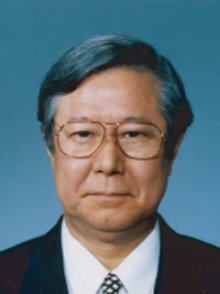
On 18 March 2026, Heisuke Hironaka passed away at his home in Tokyo at the age of 94. He was one of the great algebraic geometers of the twentieth century. His proof of resolution of singularities for algebraic varieties over a field of characteristic zero, in arbitrary dimension, transformed algebraic geometry.
At a singular point of an algebraic variety, branches may cross, a cusp may form, and the local geometry may become so complicated that many of the most powerful tools of geometry and analysis no longer apply.
A resolution replaces a singular variety X with a smooth variety Y by a proper map Y → X that changes nothing away from the singular locus.
Hironaka proved that, over a field of characteristic zero, such a map can always be constructed through a carefully controlled sequence of modifications along smooth subvarieties. Moreover, he arranged for the preimage of the singular set to have simple normal crossings, locally resembling coordinate planes meeting transversely.
Resolution of singularities became a basic passage between the singular and smooth worlds, indispensable in birational and complex geometry, Hodge theory, and many other areas of mathematics.
Hironaka was born in 1931 in Yamaguchi Prefecture, Japan, and graduated from Kyoto University in 1954. In 1956, he met Oscar Zariski, who was visiting Kyoto at the invitation of Yasuo Akizuki. Zariski encouraged Hironaka to come to Harvard, where he completed his doctorate in 1960.
His thesis systematically developed the theory of blowing up—a geometric operation that replaces a subspace by the collection of directions normal to it—and revealed how such operations organize the different birational models of the same space. This work laid important foundations for his later proof of resolution of singularities.
Once a classical technique used largely on an ad hoc basis, blowing up has become one of the central operations of algebraic geometry, underlying the elimination of indeterminacies of rational maps and the construction and comparison of birational models.
Beyond resolution of singularities, Hironaka made fundamental contributions to algebraic, complex, and real analytic geometry. His early work examined how singular spaces vary in families, identifying conditions under which properties such as dimension, normality, and the character of singularities remain stable under specialization. He also constructed a celebrated family of smooth compact complex spaces whose general members are Kähler but whose special member is not, revealing an unexpected instability in complex geometry. Hironaka obtained powerful results on flattening, a procedure that modifies a varying family of spaces so that its fibers behave uniformly. In real analytic geometry, he helped establish the modern theory of subanalytic sets, showing that these potentially complicated sets possess strong finiteness properties and admit well-behaved stratifications and triangulations.
After teaching at Brandeis and Columbia, Hironaka joined the Harvard faculty in 1968. From 1975 to 1983, he held joint appointments at Kyoto University and its Research Institute for Mathematical Sciences, serving as director of the institute from 1983 to 1985. He later served as president of Yamaguchi University from 1996 to 2002.
Hironaka organized summer seminars for young students and, in 1984, founded the Japan Association for Mathematical Sciences, which supported research, fellowships, and international exchange. He also helped create programs and competitions that allowed children to experience mathematics as a joyful and creative pursuit. Many young mathematicians were able to study abroad through the opportunities he created. His numerous honors included the Fields Medal and the Japan Academy Prize in 1970, the Order of Culture in 1975, and appointment as a Chevalier of the French Légion d’honneur in 2004.
Professor Hironaka was a visiting professor at Seoul National University in 2008 and 2009, and it was there that I met him. I was in my mid-twenties and had not yet found my way into mathematical research. Until then, mathematics had come to me mostly through books, as something distant, fixed, and almost timeless. Watching him work changed that completely. It was like hearing music performed after knowing it only from the score. I remain deeply grateful that he spoke with me so generously and so regularly, despite how little I understood at the time.
My later visits to see him in Tokyo and Kyoto only deepened my appreciation of his striking combination of great kindness and an exceptionally sharp mind.
Hironaka Heisuke resolved singularities, yet he sometimes remarked that it is irregularities that give the world its depth. His theorems changed mathematics; his generosity changed the lives of many mathematicians, including my own. For an overview of Hironaka’s mathematical work, see Lê and Teissier (2008).[1] For an account of his efforts to advance the mathematical sciences and nurture new generations of mathematicians, see Oda (2008).[2]
June Huh
Princeton University
[1] Lê Dũng Tráng and Bernard Teissier, On the mathematical work of Professor Heisuke Hironaka, Publ. Res. Inst. Math. Sci. 44 (2008), no. 2, 165–177
[2] Tadao Oda, Professor Heisuke Hironaka’s contribution in promoting mathematical sciences and bringing up talent in new generations, Publ. Res. Inst. Math. Sci. 44 (2008), no. 2, 179–182
News from the Commission for Developing Countries (CDC)
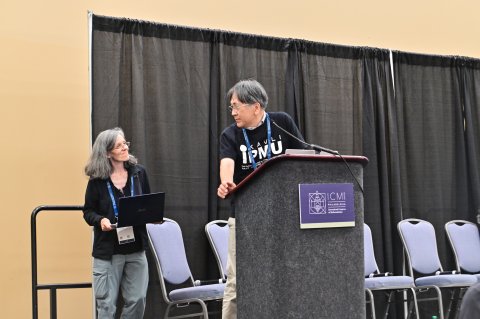
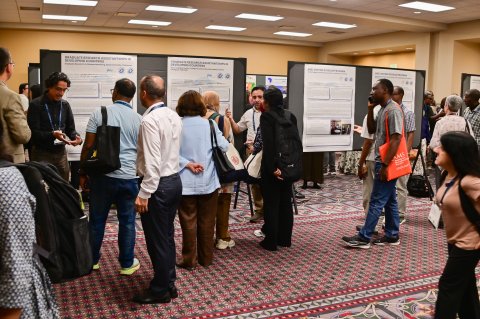
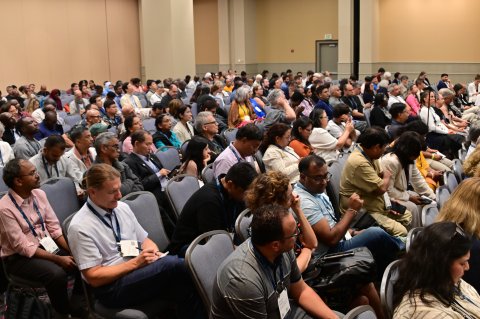
CDC Special Activity at ICM 2026. On July 28, the IMU Commission for Developing Countries (CDC) held the Special Activity Mathematical Collaboration in the Global South and Creating Opportunities, as part of ICM 2026 in Philadelphia.
The event brought together mathematicians and representatives of several institutions and organizations through a poster session, a series of short communications, and a panel discussion, all devoted to the challenges and opportunities involved in strengthening mathematical research in the Global South.
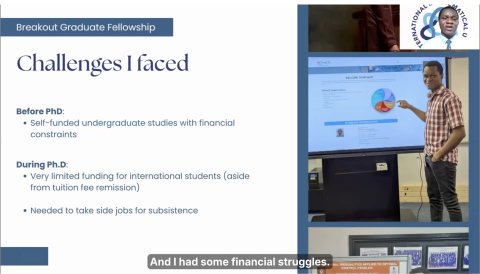
Grantees Victor Amarachi Uzor, Anjana Pokharel and Claudia Lederman shared their experiences with the IMU Breakout Graduate Fellowship, GRAID program and IMU-Simons Research Fellowship, respectively. The panel discussion provided an opportunity to exchange ideas on international collaboration and the challenges and opportunities facing mathematical communities in developing countries.
The activity was a great success thanks to the lively discussions, fruitful exchanges and active participation of everyone in attendance. We warmly thank all the poster presenters, speakers, panelists, participants, and organizers who contributed to making the event a success.
More information, including the program and presentation slides, is available on the CDC Special Activity at ICM 2026 webpage.
We are pleased to share some photos taken during the event below.
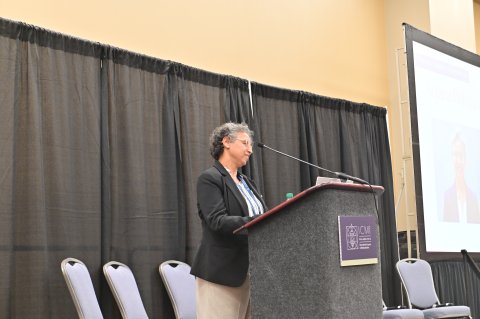
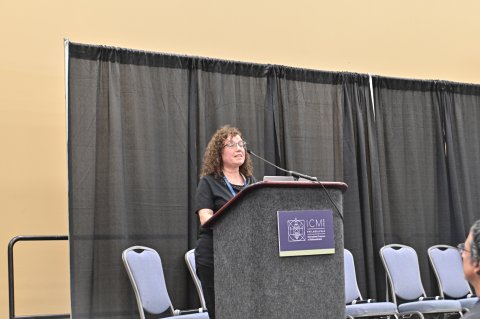
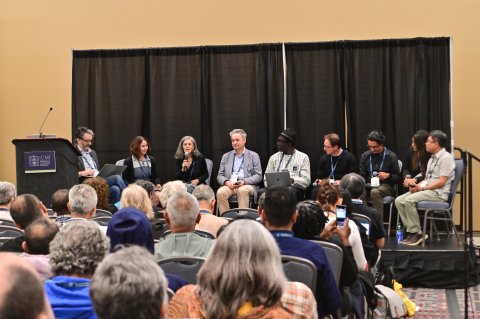
Beyond this special event, the CDC continues its work through a range of programs supporting mathematicians in developing countries.
Current opportunities and deadlines. Several CDC-supported programs and opportunities are currently open and accepting applications:
- Conference Support Program. Next deadline: October 1, 2026, for conferences starting after February 1, 2027
- IMU-Simons Research Fellowship Program for Developing Countries. Next deadline: October 1, 2026, for research visits starting between February 15, 2027, and February 15, 2028
- Abel Visiting Scholar Program for Graduate Students. Application deadline: September 15, 2026, for research visits starting between February 1, 2027, and December 31, 2027
- Volunteer Lecturer Program. Next deadline: October 15, 2026, for courses to be held between March 1, 2027, and March 1, 2028
News from the Committee for Women in Mathematics (CWM)
CWM is happy to report on the success of the two activities it organized around ICM 2026 in Philadelphia in partnership with the Association for Women in Mathematics (AWM): the third edition of (WM)², the World Meeting for Women in Mathematics, and the panel discussion Finding and Defining Success in Mathematics: Pathways and Measures.
World Meeting for Women in Mathematics – (WM)². Held on the day preceding the ICM, (WM)² aims to strengthen professional networks among women mathematicians while promoting their full participation in the Congress. It highlights the contributions of women mathematicians from the region in which the ICM is held and is open to the entire mathematical community.
The third edition of (WM)² took place on 22 July 2026 in a hybrid format at the Pennsylvania Convention Center in Philadelphia and online via Zoom. The meeting had approximately 280 registered in-person participants, 150 of whom were recipients of ICM travel support from developing countries. In addition, nearly 120 people participated online. Altogether, (WM)² brought together participants from 78 countries.
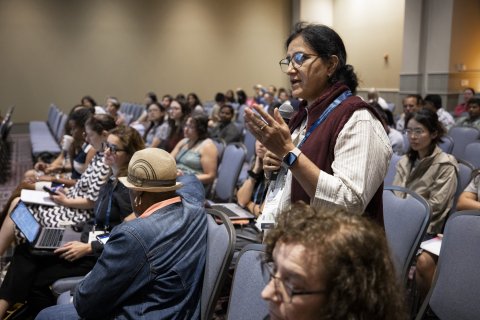
The scientific program reflected the breadth and vitality of contemporary mathematics. Participants enjoyed outstanding lectures by Kirsten Eisenträger, Luz de Teresa, Chelsea Walton, and Melanie Weber, covering topics ranging from cryptography and partial differential equations to algebra and deep learning. The program also included small-group discussions over lunch, a poster session featuring approximately 50 posters, and opportunities for networking throughout the day.
The meeting opened with welcoming remarks by Ulrike Tillmann, incoming President of the IMU, Ravi Vakil, President of the American Mathematical Society, and Talitha Washington, Past President of the AWM, highlighting the importance of international collaboration in fostering an inclusive mathematical community.
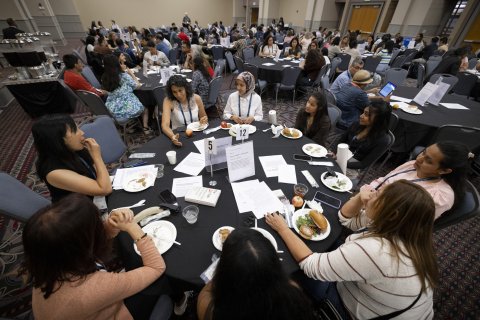
Panel Discussion. The day concluded with the panel discussion Imagining Mathematics in the Future: Hopes and Challenges, featuring Maria Klawe, Jaqueline Mesquita, Talitha Washington, and Lauren Williams. The panel explored how mathematics is being transformed by technological advances, evolving educational practices, and changing societal needs, while reflecting on the role mathematicians can play in shaping a more inclusive, creative, and impactful future for the discipline. The meeting closed with remarks by IMU President Hiraku Nakajima and Tiffany Vlaar, representing the organizing committee of ICM 2030, who invited participants to the fourth edition of (WM)², to be held in Glasgow in July 2030.
ICM 2026. The following day, the ICM officially began. CWM warmly congratulates all IMU Prize winners, especially Fields Medalist Hong Wang and Leelavati Prize recipient Hannah Fry, whose achievements are an inspiration to the mathematical community.
The collaboration between the CWM and the AWM continued during the ICM itself with the jointly organized panel Finding and Defining Success in Mathematics: Pathways and Measures, held on 24 July 2026. Featuring Annalisa Crannell, Fern Hunt, Emily Riehl, and Shelby Wilson, the discussion challenged traditional notions of success in mathematics by highlighting diverse professional trajectories spanning research, leadership, industry, and public engagement. Through personal experiences and thoughtful reflections, the panel encouraged participants to embrace broad and inclusive perspectives on achievement and impact within the mathematical community.
CWM thanks everyone who contributed to the success of these activities and looks forward to continuing this work with the international mathematical community at ICM 2030 in Glasgow.
In the process of writing this piece, we used AI for language editing and proofreading.
Carolina Araujo and Hélène Barcelo
Chair and Vice-Chair of the IMU Committee for Women in Mathematics
News from the International Day of Mathematics (IDM)
The International Day of Mathematics (IDM) has now been celebrated for seven years. There are events all over the world and every year organizations are invited to post their events on the IDM map.
Every year a theme is chosen to flavor the celebration of the IDM on March 14, to spark creativity and to shed light on connections between mathematics and all sorts of fields, concepts and ideas.
The IDM 2027 theme is
MATHEMATICS, AI AND OUR FUTURE
We hear of AI all the time: it is described as the new development that will revolutionize the way we work, the way we think, the way we behave in society. And we hear that AI develops at a speed out of control. But how should we approach it? To answer this, we must first have a look at what AI is. AI runs on mathematics: algorithms, which exploit data to draw conclusions, using techniques from linear algebra, calculus, probability, statistics, etc. AI is a very powerful tool. What are its strengths? What are its dangers? One purpose of the IDM 2027 theme is to demystify AI, so as to empower anyone to function in this new paradigm. AI is or will be everywhere. How will AI affect research? How can we trust the validity of its results? How will it affect education? How will it affect humanity? IDM 2027 wishes to discuss and understand how AI should be used, from kindergarten to research, as a tool for the development of humanity.
The IMU General Assembly and ICM 2026. At the 2026 IMU General Assembly, the IDM Project was presented to all delegates, and the allocation of 2% of the IMU budget to IDM was approved.
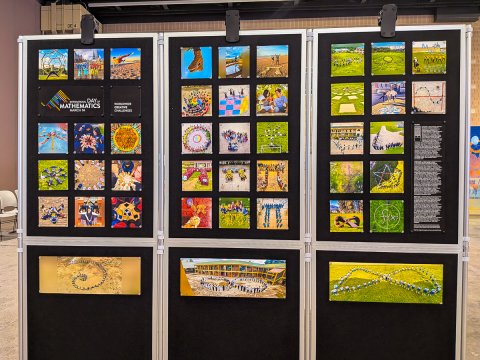
On July 24, at the exhibition hall of the Convention Center where ICM 2026 took place, an IMAGINARY exhibition was opened where the IDM 2027 theme was presented.
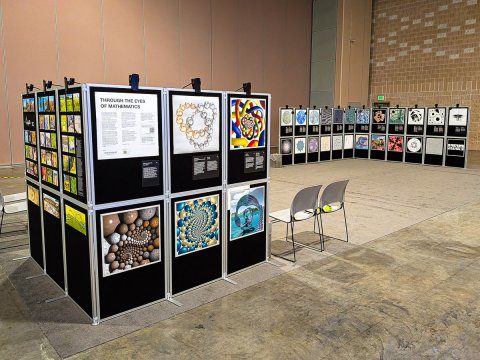
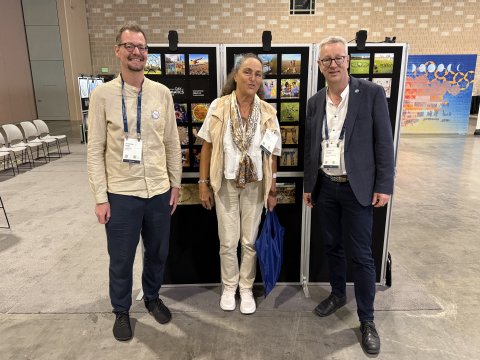
You are invited to subscribe to the IDM Newsletter in order to learn more about the resources and activities (including the annual challenge) around IDM 2027.
Betül Tanbay
Chair of the IDM Governing Board
Subscribing to IMU News
To subscribe to IMU News, please click here. When you subscribe, you will receive an e-mail message to confirm your subscription so that misuse will be minimized.
IMU will not use the list of IMU News emails for any purpose other than sending IMU News, and will not make it available to others.
Previous issues can be seen here.